
Sunrise and Sunset Times in the United States
| Location | Oct 15 (Thu) | Oct 16 (Fri) | ||||
|---|---|---|---|---|---|---|
| Sunrise | Sunset | Weather | Sunrise | Sunset | Weather | |
| Portland, ME | 6:54 AM | 5:59 PM |
 59°F / 46°F |
6:55 AM | 5:57 PM |
 57°F / 45°F |
| Manchester, NH | 6:58 AM | 6:04 PM |
 60°F / 42°F |
6:59 AM | 6:03 PM |
 61°F / 45°F |
| Boston, MA | 6:55 AM | 6:03 PM |
61°F / 50°F |
6:57 AM | 6:02 PM |
67°F / 50°F |
| Providence, RI | 6:56 AM | 6:05 PM |
63°F / 47°F |
6:57 AM | 6:04 PM |
67°F / 51°F |
| Hartford, CT | 7:01 AM | 6:11 PM |
63°F / 47°F |
7:02 AM | 6:09 PM |
66°F / 50°F |
| New York City, NY | 7:06 AM | 6:17 PM |
65°F / 58°F |
7:07 AM | 6:15 PM |
69°F / 52°F |
| Newark, NJ | 7:06 AM | 6:18 PM | -- | 7:07 AM | 6:16 PM | -- |
| Philadelphia, PA | 7:10 AM | 6:22 PM |
67°F / 57°F |
7:11 AM | 6:21 PM |
72°F / 53°F |
| Baltimore, MD | 7:15 AM | 6:29 PM |
 64°F / 60°F |
7:16 AM | 6:27 PM |
81°F / 54°F |
| Washington D.C., DC | 7:16 AM | 6:31 PM |
69°F / 60°F |
7:17 AM | 6:29 PM |
83°F / 54°F |
| Virginia Beach, VA | 7:10 AM | 6:28 PM |
72°F / 67°F |
7:11 AM | 6:27 PM |
82°F / 63°F |
| Charlotte, NC | 7:28 AM | 6:49 PM |
89°F / 61°F |
7:29 AM | 6:48 PM |
86°F / 55°F |
| Charleston, SC | 7:22 AM | 6:48 PM |
86°F / 70°F |
7:23 AM | 6:46 PM |
84°F / 70°F |
| Atlanta, GA | 7:41 AM | 7:05 PM |
88°F / 64°F |
7:42 AM | 7:03 PM |
83°F / 49°F |
| Jacksonville, FL | 7:27 AM | 6:56 PM |
86°F / 67°F |
7:28 AM | 6:55 PM |
88°F / 68°F |
| Birmingham, AL | 6:50 AM | 6:14 PM |
89°F / 62°F |
6:51 AM | 6:13 PM |
84°F / 48°F |
| Jackson, MS | 7:03 AM | 6:29 PM |
89°F / 62°F |
7:04 AM | 6:28 PM |
77°F / 49°F |
| New Orleans, LA | 7:01 AM | 6:30 PM |
87°F / 72°F |
7:01 AM | 6:29 PM |
85°F / 57°F |
| Little Rock, AR | 7:13 AM | 6:35 PM |
90°F / 63°F |
7:14 AM | 6:34 PM |
 64°F / 45°F |
| Nashville, TN | 7:53 AM | 7:12 PM |
86°F / 68°F |
7:53 AM | 7:11 PM |
68°F / 47°F |
| Louisville, KY | 7:50 AM | 7:06 PM |
 80°F / 69°F |
7:51 AM | 7:05 PM |
68°F / 46°F |
| Columbus, OH | 7:41 AM | 6:54 PM |
70°F / 57°F |
7:42 AM | 6:52 PM |
69°F / 45°F |
| Indianapolis, IN | 7:53 AM | 7:06 PM |
70°F / 61°F |
7:54 AM | 7:05 PM |
59°F / 43°F |
| Detroit, MI | 7:43 AM | 6:51 PM |
62°F / 54°F |
7:45 AM | 6:50 PM |
62°F / 40°F |
| Chicago, IL | 7:01 AM | 6:10 PM |
64°F / 51°F |
7:02 AM | 6:09 PM |
53°F / 43°F |
| Milwaukee, WI | 7:04 AM | 6:10 PM |
58°F / 50°F |
7:05 AM | 6:08 PM |
52°F / 37°F |
| Minneapolis, MN | 7:27 AM | 6:29 PM |
48°F / 44°F |
7:28 AM | 6:28 PM |
50°F / 31°F |
| Des Moines, IA | 7:25 AM | 6:34 PM |
58°F / 46°F |
7:26 AM | 6:33 PM |
51°F / 30°F |
| Kansas City, MO | 7:26 AM | 6:41 PM |
67°F / 47°F |
7:27 AM | 6:39 PM |
52°F / 35°F |
| Omaha, NE | 7:34 AM | 6:44 PM |
53°F / 46°F |
7:35 AM | 6:43 PM |
52°F / 30°F |
| Wichita, KS | 7:36 AM | 6:53 PM | -- | 7:37 AM | 6:52 PM | -- |
| Oklahoma City, OK | 7:35 AM | 6:56 PM |
71°F / 50°F |
7:36 AM | 6:54 PM |
58°F / 37°F |
| Houston, TX | 7:22 AM | 6:52 PM |
89°F / 72°F |
7:22 AM | 6:51 PM |
 72°F / 53°F |
| Albuquerque, NM | 7:11 AM | 6:32 PM |
71°F / 42°F |
7:12 AM | 6:31 PM |
64°F / 35°F |
| Phoenix, AZ | 6:31 AM | 5:56 PM |
87°F / 59°F |
6:32 AM | 5:54 PM |
86°F / 69°F |
| Denver, CO | 7:09 AM | 6:22 PM |
52°F / 30°F |
7:10 AM | 6:20 PM |
57°F / 30°F |
| Boise, ID | 7:58 AM | 7:03 PM |
69°F / 41°F |
7:59 AM | 7:01 PM |
73°F / 42°F |
| Salt Lake City, UT | 7:37 AM | 6:48 PM |
64°F / 43°F |
7:38 AM | 6:47 PM |
68°F / 42°F |
| Las Vegas, NV | 6:46 AM | 6:05 PM |
81°F / 60°F |
6:47 AM | 6:04 PM |
84°F / 63°F |
| Los Angeles, CA | 6:57 AM | 6:20 PM |
91°F / 64°F |
6:57 AM | 6:18 PM |
96°F / 75°F |
| Portland, OR | 7:26 AM | 6:26 PM |
76°F / 51°F |
7:27 AM | 6:25 PM |
76°F / 51°F |
| Seattle, WA | 7:27 AM | 6:22 PM |
66°F / 49°F |
7:28 AM | 6:21 PM |
73°F / 51°F |
| Anchorage, AK | 8:41 AM | 6:49 PM |
46°F / 39°F |
8:43 AM | 6:46 PM |
47°F / 38°F |
| Honolulu, HI | 6:26 AM | 6:08 PM |
83°F / 78°F |
6:26 AM | 6:07 PM |
82°F / 78°F |
Browse All States
- Cape Coral
- Clearwater
- Coral Springs
- Davie
- Fort Lauderdale
- Fort Myers
- Gainesville
- Hialeah
- Hollywood
- Islamorada
- Jacksonville
- Key Largo
- Key West
- Lakeland
- Marathon
- Marco Island
- Miami
- Miami Gardens
- Miramar
- Orlando
- Palm Bay
- Pembroke Pines
- Pompano Beach
- Port St. Lucie
- Sanibel Island
- St. Petersburg
- Tallahassee
- Tampa
- West Palm Beach
- Abilene
- Amarillo
- Arlington
- Austin
- Beaumont
- Brownsville
- Carrollton
- College Station
- Conroe
- Corpus Christi
- Dallas
- Denton
- Edinburg
- El Paso
- Fort Worth
- Frisco
- Garland
- Grand Prairie
- Houston
- Irving
- Killeen
- Laredo
- League City
- Lewisville
- Lubbock
- McAllen
- McKinney
- Mesquite
- Midland
- New Braunfels
- Odessa
- Pasadena
- Pearland
- Plano
- Richardson
- Round Rock
- San Antonio
- Sugar Land
- Tyler
- Waco
- Anaheim
- Antioch
- Bakersfield
- Berkeley
- Burbank
- Carlsbad
- Catalina Island
- Chula Vista
- Clovis
- Concord
- Corona
- Costa Mesa
- Daly City
- Downey
- El Cajon
- El Monte
- Elk Grove
- Escondido
- Fairfield
- Fontana
- Fremont
- Fresno
- Fullerton
- Garden Grove
- Glendale
- Hayward
- Huntington Beach
- Inglewood
- Irvine
- Lancaster
- Long Beach
- Los Angeles
- Modesto
- Moreno Valley
- Murrieta
- Norwalk
- Oakland
- Oceanside
- Ontario
- Orange
- Palmdale
- Pasadena
- Pomona
- Rancho Cucamonga
- Richmond
- Riverside
- Roseville
- Sacramento
- Salinas
- San Bernardino
- San Diego
- San Francisco
- San Jose
- San Mateo
- Santa Ana
- Santa Clara
- Santa Clarita
- Santa Cruz Island
- Santa Rosa
- Simi Valley
- Stockton
- Sunnyvale
- Temecula
- Thousand Oaks
- Torrance
- Vallejo
- Victorville
- Visalia
- West Covina
Sunrise & Sunset Map Across the United States
The shaded area represents regions currently in darkness.
Light Levels Before Sunrise and After Sunset (The 3 Twilights)
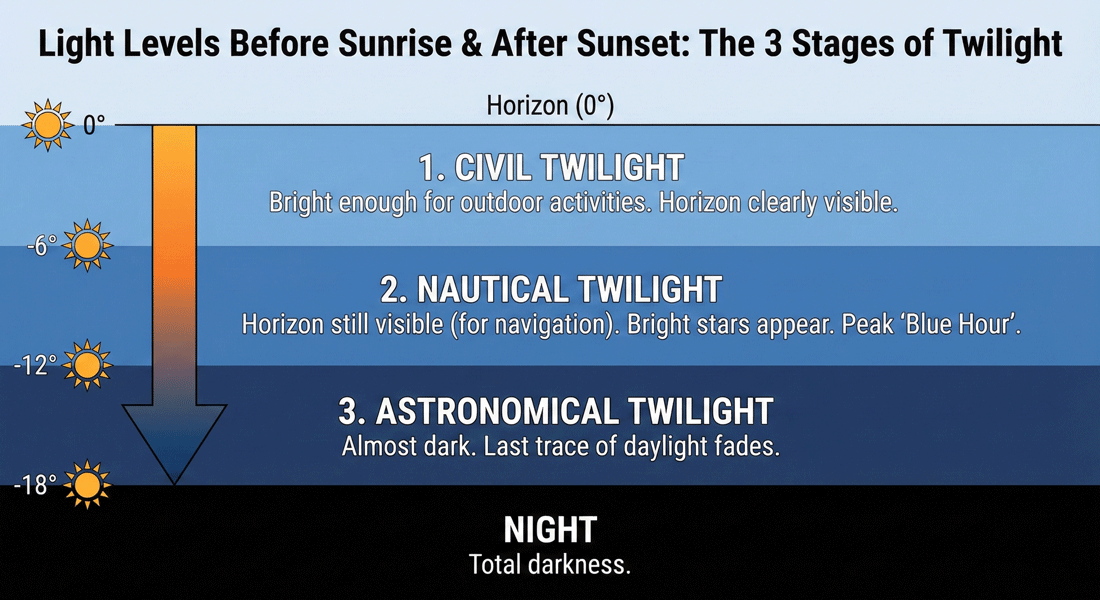
The sky doesn't turn pitch black immediately after sunset, nor is it dark until the very moment of sunrise. Even when the sun is below the horizon, the atmosphere scatters light, creating a period of gradual transition.
This period is known as "Twilight."
Twilight is scientifically divided into three stages based on the sun's angle below the horizon. Understanding these can help you plan your dawn patrol or evening sessions more effectively.
1. Civil Twilight
【Brightness Level】 Enough light for outdoor activities.
This occurs when the sun is between 0° and 6° below the horizon. It typically lasts about 30 minutes before sunrise and after sunset (though this varies by latitude and season).
Maritime Utility:
The sky is bright enough to see clearly, and you can generally read a newspaper outdoors without artificial light.
Surfing: You can see the set waves clearly. This is when the "Dawn Patrol" crowd usually hits the water.
Fishing: You can tie knots and rig your gear without needing a headlamp.
2. Nautical Twilight
【Brightness Level】 The horizon is visible, and bright stars appear.
The sun is between 6° and 12° below the horizon. This period is the "Blue Hour" favored by photographers.
Maritime Utility:
As the name suggests, this was the time when sailors could navigate by using the stars while still being able to see the horizon line for reference.
Photography: This is the peak of the "Blue Hour," where the world is bathed in deep indigo hues.
Fishing: This often marks the beginning of the "morning bite" as fish activity increases. However, it is generally still too dark for safe surfing without adequate light.
3. Astronomical Twilight
【Brightness Level】 Near total darkness (Limit for stargazing).
The sun is between 12° and 18° below the horizon.
Maritime Utility:
To the naked eye, it feels like total night. Only once this stage ends is the sky truly dark enough for sensitive astronomical observations. For most maritime activities, this is simply considered "Night."
What is Sunrise?
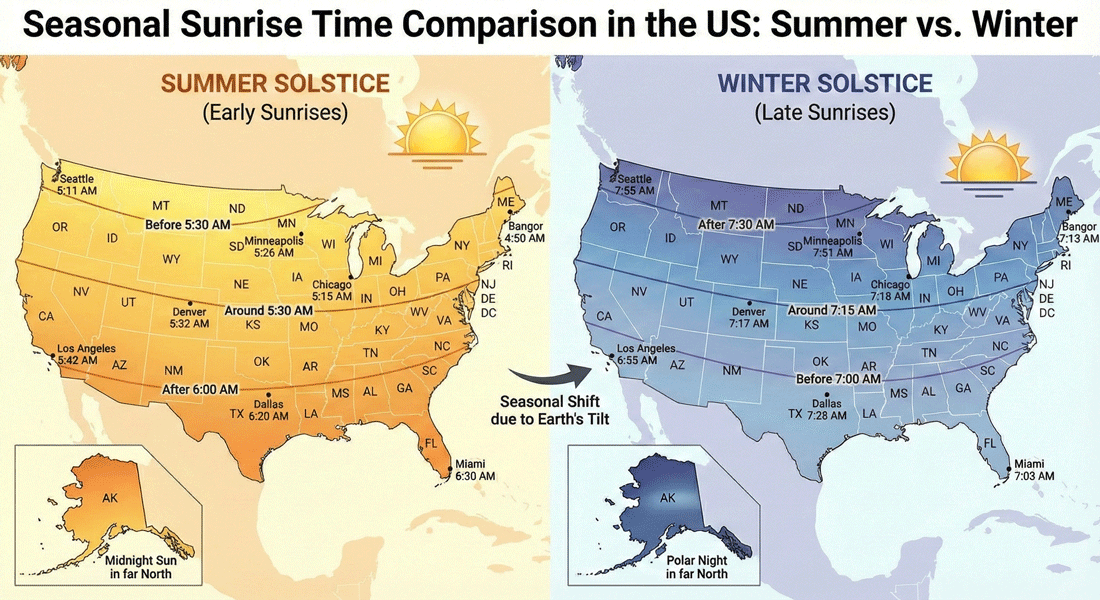
Sunrise is the moment the top edge of the sun appears on the horizon. In high-latitude regions like the Northern US and Alaska, the timing varies drastically between seasons. In summer, the sun rises extremely early, while in winter, it can be quite late. In lower-latitude areas like Florida or Hawaii, the variation is much less pronounced throughout the year.
In the Lower 48, West Quoddy Head, Maine, is the easternmost point. However, due to the Earth's tilt, Cadillac Mountain in Acadia National Park, Maine, is famous for seeing the first sunrise in the US during the autumn and winter months.
Interestingly, because of the International Date Line, the first place in all of US territory to see the sunrise is technically Point Udall, Guam—the place "Where America's Day Begins."
What is Sunset?
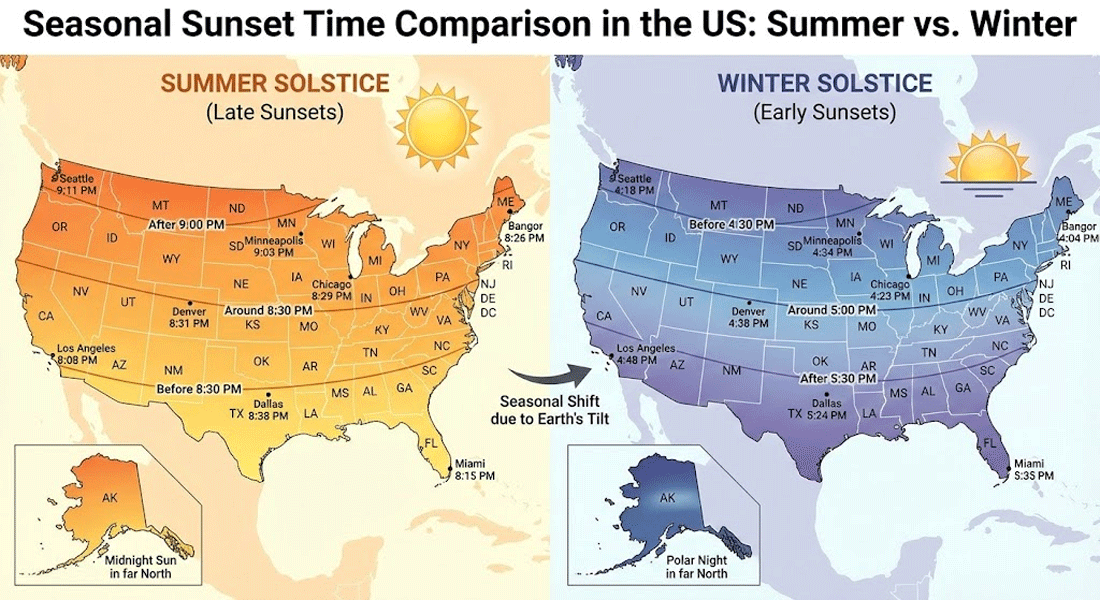
Sunset is the moment when the trailing edge of the sun disappears below the horizon. Similar to sunrise, high-latitude states (like Washington or Maine) experience long summer evenings where it stays light until 9 PM or later, while winter sunsets occur as early as 4 PM.
In Northern Alaska, above the Arctic Circle, the sun does not set at all for weeks during the summer—a phenomenon known as the "Midnight Sun." Conversely, in the dead of winter, these regions experience "Polar Night," where the sun never rises above the horizon, staying in a state of perpetual twilight or darkness.
Frequently Asked Questions
Q: Why is early morning or late evening best for surfing and fishing?
Beyond fish being more active (the "bite"), it often comes down to Wind. As the land heats up during the day, sea breezes typically pick up, making the water choppy. Early morning and late evening often provide "Glassy" conditions with little to no wind, making for perfectly clean waves and better lure control.
Q: What is "Magic Hour"?
It's a general term for the period around sunrise and sunset when the light is most dramatic and beautiful. It includes the "Golden Hour" (warm, gold tones) and the "Blue Hour" (cool, indigo tones). It is the most coveted time for photographers and cinematographers.
Q: When exactly does "Blue Hour" happen?
Blue Hour occurs during Nautical Twilight—just before sunrise and just after sunset. The sun is below the horizon, so there is no direct glare, but the sky glows with a deep blue gradient that reflects beautifully off the ocean surface.
Q: How is it different from "Golden Hour"?
Golden Hour happens when the sun is just above the horizon—shortly after sunrise and shortly before sunset. The light is warm, soft, and creates long, dramatic shadows. While Blue Hour is calm and serene, Golden Hour feels warm and vibrant.
Q: How long before the official sunrise time does it start to get light?
Usually, the sky begins to brighten about 30 to 60 minutes before the official sunrise (this is Civil Twilight). If you want to be the first one in the lineup as soon as there is enough light to see, plan to be at the beach at least 30 minutes before the official sunrise time.
Q: Which day has the most daylight?
The Summer Solstice, which occurs around June 21st in the Northern Hemisphere. In cities like Seattle, you can enjoy over 15 hours of daylight on this day.
Q: Which day has the least daylight?
The Winter Solstice, around December 21st. This is the shortest day of the year, with some northern regions seeing less than 8 or 9 hours of sun.
Q: Is the earliest sunrise on the Summer Solstice?
Actually, no. For most of the US, the earliest sunrise occurs about a week or two before the Summer Solstice, and the latest sunset occurs a week or two after. The solstice is simply the day with the longest total duration of light.